Why Dentists Spend So Much Time on Administrative Tasks
The administrative workload goes well beyond clinical reports. Discover why these tasks pile up, how they affect dentists, and how technology can help them reclaim their time.
Alexandre von Rakowski9 min read
Updated on August 10, 2026
Key takeaways from this article
Why administrative tasks aren't limited to writing reports.
How small interruptions end up adding up to several hours each week.
What impact this workload has on stress and the quality of care.
How new technologies can give practitioners back their time.
Every dentist chose this profession for one reason: to care for patients.
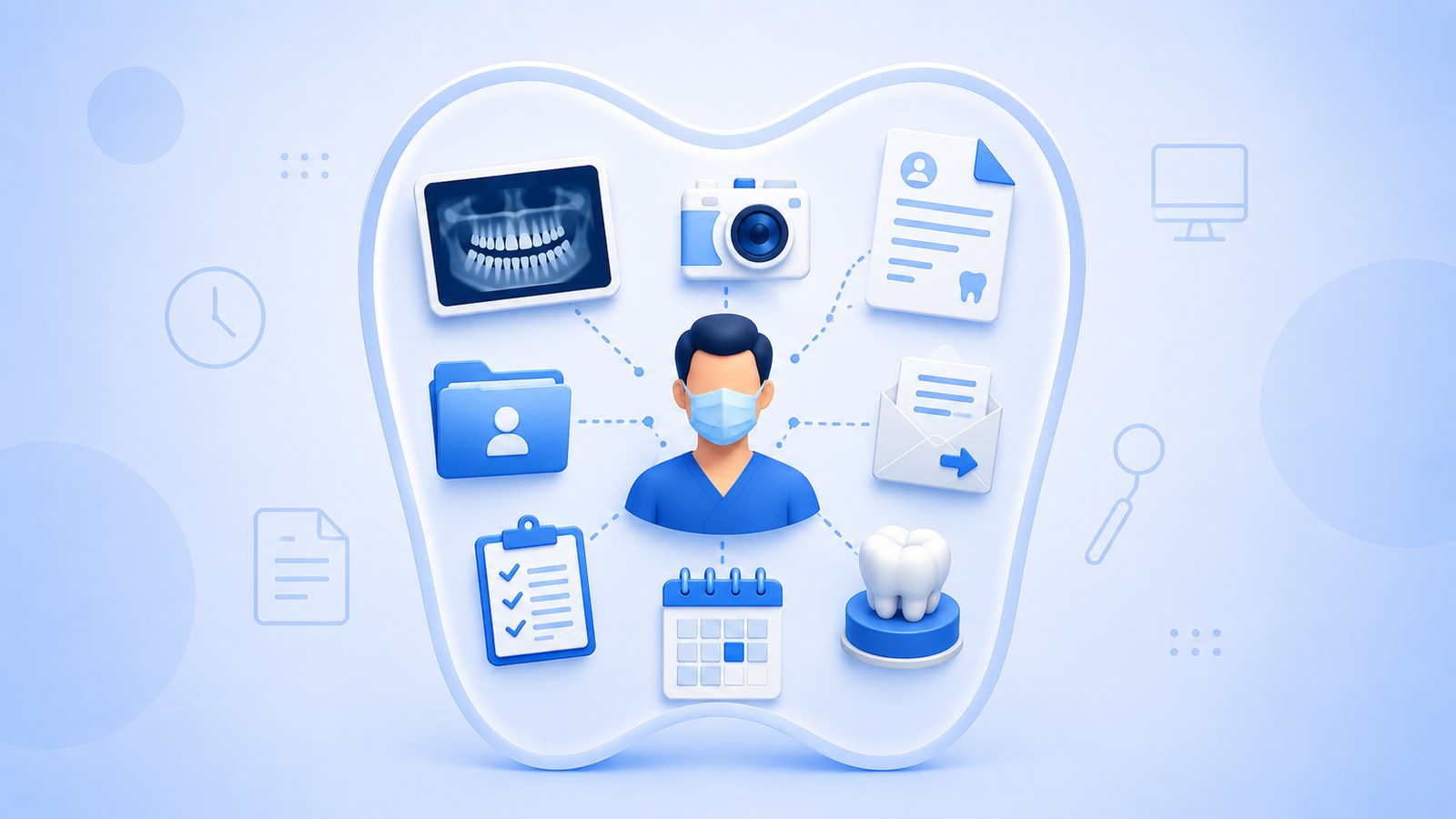
Even before starting a treatment, you have to find the right x-rays, open several pieces of software, check medical history, search for photographs, review ongoing treatments, or prepare the patient's file.
After each appointment, the list goes on: writing a clinical report, updating the file, sending a referral letter, communicating with the lab, filing documents, answering patient messages…
Benjamin Bénichou, a dental surgeon for more than twenty years and co-founder of CadSmile, sums up this reality in one sentence:
“
“My job is to care for people, not to do paperwork.”
— Benjamin Bénichou, 20 years of experience
Taken individually, each of these tasks takes only a few minutes. But repeated throughout the day, they end up representing several hours of work each week.
This frustration isn't limited to a single practitioner. Throughout our conversations with several dental surgeons and orthodontists, this observation came up again and again: administrative tasks take up a significant place in their daily routine.
This reality is now widely recognized by healthcare professionals and confirmed by several studies, which we'll discuss later in this article.
As software evolves, many repetitive tasks can be simplified, automated, or brought together within a single work environment. This is precisely the vision that guided the development of CadSmile: to let practitioners spend more time with their patients rather than with their computer.
To better understand where this administrative workload really hides, let's follow the course of an appointment, before, during, and after the patient sits in the chair.
Before
Prepare the file
Review x-rays
Check treatments
During
Photograph
Annotate
Document
After
Write the report
Send letters
Communicate with the lab
What are a dentist's administrative tasks?
When people talk about administrative workload, they often think of writing the report after the appointment.
In reality, it accompanies the dentist throughout the entire patient journey.
Even before seeing the patient
Even before the patient sits down in the chair, several tasks are already necessary:
Reviewing medical history.
Finding x-rays.
Opening clinical photographs.
Checking ongoing treatments.
Preparing the patient's file.
Looking up a recommendation or a drug interaction.
Benjamin explains that even before starting certain treatments, he sometimes has to open several pieces of software to find all the information he needs.
During treatment
During the appointment, new tasks are added: taking photographs, documenting clinical observations, annotating exams, updating the patient's file, or preparing the elements needed for a future treatment plan.
After the patient leaves
Then comes the post-appointment work: writing the report, referral letter, prescriptions, communication with the dental lab, filing documents, sending information to the patient… The list is long.
Why do these tasks become a problem?
These tasks are essential to ensure continuity of care and traceability of clinical decisions. The problem, then, isn't that they exist, but that they're spread across several pieces of software that don't always communicate with one another.
Benjamin Bénichou sums up this reality well:
“When I need to get something very specific for my work, there are two ways to do it. The first is to use several pieces of software. You export files, import them elsewhere, go from Blender to other specialized software, then tinker until you get the result you want. The second is simply not to do it.”— Benjamin Bénichou
When tools are too complex or too time-consuming, some genuinely useful processes end up being abandoned. Benjamin gives the example of the digital wax-up, an essential step for planning certain esthetic or implant restorations, which many practitioners give up on because the process is too cumbersome.
The goal, then, isn't just to save time, but also to make accessible good practices that some practitioners end up abandoning for lack of sufficiently simple tools.
It's precisely to avoid this back-and-forth between pieces of software that CadSmile centralizes clinical information within a Virtual Patient, bringing together x-rays, photographs, clinical documents, and the patient's history within a single space.
If each of these tasks only takes a few seconds or a few minutes, why do they end up giving the impression of wasting so much time?
Why do small tasks waste so much time?
Micro-tasks pile up…
It's usually not a single task that wastes time.
It's dozens of micro-interruptions spread throughout the day.
A few clicks to export a file.
A few seconds to find a photograph.
An internet search to check a recommendation.
Copy-pasting between two pieces of software.
Taken individually, these actions seem trivial.
But when they're repeated dozens of times a day, they end up accounting for a significant share of a dentist's working time.
Software isn't designed for dentists' daily routines…
Benjamin Bénichou experiences this every day.
“When you export a file in software like 3Shape, the default format offered is DICOM, even though most of the time you're working in STL or PLY. The software doesn't even remember the last format used. Every time you export, you have to reconfigure everything. These are very small things, but they become extremely tedious when you repeat them dozens of times a day.”— Benjamin Bénichou
This account illustrates a broader problem: most software was designed to perform a specific task, but rarely to integrate naturally into a practice's daily routine. Dentists end up juggling several tools, multiplying manipulations, and constantly recreating information that already exists elsewhere.
The hidden cost of context switching…
Beyond the loss of time, these interruptions carry a cognitive cost.
With every change of software or context, the brain has to refocus. This succession of micro-tasks increases mental load, encourages mistakes, and makes days more tiring than they should be. Recent research on documentation burden in healthcare professions shows that these administrative tasks are in fact one of the leading causes of professional fatigue and burnout.
Reducing friction, not just clicks…
The goal isn't just to remove a few clicks, but to reduce all the invisible friction that turns a day of patient care into a day of administration. That's precisely what CadSmile's Voice Notes, Document Generation and Virtual Patient features make possible, cutting down on repetitive manipulations by centralizing information and by simplifying and automating certain low-value tasks.
What impact do administrative tasks have on dentists?
A mental load that keeps building up…
When people talk about administrative workload, they naturally think of lost time.
But the real cost is often elsewhere.
Every interruption forces the practitioner to break off their clinical reasoning to fill out a document, look up information, answer a message, or navigate between several pieces of software.
By the end of the day, it's not just time that's missing. It's also mental energy.
Studies that confirm this observation…
This cognitive burden is now well documented. A systematic review published in 2024, covering 135 studies, identifies clinical documentation, administrative tasks, and the proliferation of digital tools as major factors of professional fatigue among caregivers. The authors note that they reduce the time devoted to patients and contribute to burnout.
Dental surgeons are no exception. A survey published in 2025 in the British Dental Journal, conducted among more than 1,600 dental professionals in the United Kingdom, found that nearly two out of three practitioners report regularly feeling burned out. Among the main causes cited are workload, organizational constraints, and non-clinical tasks.
More time doesn't mean more patients…
For Benjamin Bénichou, the time saved through better tools shouldn't be used to squeeze in more appointments.
It should make it possible to practice the profession better.
“They'll have less stress, fewer back-and-forths, better organization, and they'll reach a higher level of quality in far less time.”— Benjamin Bénichou
That's an important nuance.
Giving back time to what truly matters…
The goal isn't to turn dentists into machines that produce more procedures.
The goal is to give them back time to think through their cases, explain treatments to their patients, discuss with colleagues, and rediscover the pleasure of practicing their profession.
Ultimately, administrative tasks only become a problem when they take precedence over what constitutes the essence of the profession: the relationship with the patient and the quality of care.
At CadSmile, we believe that technology should reduce administrative workload, not to speed up appointments, but to allow practitioners to devote more time to their patients.
How technology can give dentists back their time
Digitizing is no longer enough…
For a long time, dental software was designed to digitize existing tasks.
We went from paper to screen.
But in many cases, the work stayed the same: you still have to enter information, navigate between several pieces of software, find the right files, and repeat similar actions from one patient to the next.
AI is becoming a true assistant…
Artificial intelligence is gradually changing this approach.
Instead of being a simple data-entry tool, it's becoming a true assistant capable of analyzing information, retrieving a document, structuring clinical observations, or automatically generating certain content.
The goal isn't to make decisions in place of the practitioner.
The goal is to eliminate repetitive tasks that bring no clinical value.
Assisting the practitioner, not replacing them…
Benjamin Bénichou sums up this vision simply:
“
“AI can only help. It will never replace a dentist, because it can't treat patients. Today, it's simply there to assist the practitioner.”
— Benjamin Bénichou, Dental surgeon, co-founder of CadSmile
Every minute saved counts…
This is precisely the philosophy that guided the design of CadSmile.
Rather than developing a specialized tool for every need, the goal is to bring together all of the patient's information within a Virtual Patient. From this foundation, the practitioner can find documents, generate a report, prepare a Smile Design, look up a clinical recommendation or access the patient's history without multiplying pieces of software.
Every feature saves a few minutes: around twenty minutes for a Smile Design, about ten for a radiology report, and several more minutes thanks to instant access to clinical information. Taken individually, these gains seem modest. Together, they reduce administrative workload, limit interruptions, and give practitioners back precious time to devote to their patients.
Conclusion: giving time back to the dentist, not to admin
Administrative workload is now part of daily life in every dental practice.
It's not limited to a few reports written at the end of the day. It's present before, during, and after every appointment. It's dozens of small tasks, clicks, searches, and software switches that end up eating away at precious time.
The problem, then, isn't just the number of hours lost. It's everything those hours prevent you from doing.
Taking the time to explain a treatment plan.
Thinking more calmly about a complex case.
Pursuing training.
Discussing with a colleague.
Or simply finishing the day a little earlier.
Technology will never replace clinical expertise, experience, or the relationship of trust between a dentist and their patient.
On the other hand, it can remove a large share of the repetitive tasks that bring no medical value.
That's precisely CadSmile's ambition.
By centralizing patient information, automating time-consuming tasks, and bringing several tools together within a single platform, CadSmile helps practitioners spend less time on administration and more on what truly matters: their patients.
Because dentists deserve better than spending their day managing software.
What if you got some of that time back?
CadSmile was designed by dentists, for dentists, with one simple goal: reduce the time spent on repetitive tasks so you can focus on what truly matters: your patients.
Whether you want to save time on your documentation, centralize your patients' information, or simplify your clinical workflow, CadSmile supports you every day with:
Centralizing all your patients' information with the Virtual Patient.
Writing your clinical notes faster with Voice Notes.
Creating esthetic simulations in moments with Smile Design.
Clinical documentation is essential to patient care, but it also accounts for a significant share of dentists’ nonclinical workload. Discover how AI can help create documents faster, more clearly, and more efficiently—without replacing professional judgment.
Choosing dental AI software is about more than comparing features or prices. Discover the criteria that will actually affect your day-to-day practice and learn how to evaluate any solution before committing.
After the shift from paper to digital records, patient documentation is evolving again. With AI, a record can now develop and grow throughout a patient’s care. This is the emergence of the Virtual Patient.

'%3e%3cpath%20fill-rule='evenodd'%20clip-rule='evenodd'%20d='M420.772%20832.234C332.272%20831.034%20210.629%20866.975%20159.106%20793.668C103.834%20715.026%20228.352%20629.692%20214.954%20539.396C203.537%20462.446%2097.1543%20410.994%2090.9059%20334.016C84.3003%20252.639%20113.772%20163.588%20180.882%20119.646C248.103%2075.6319%20347.965%20119.629%20432.026%20110.661C513.71%20101.946%20587.855%2038.3836%20668.31%2067.6438C748.683%2096.8743%20794.553%20182.763%20832.911%20256.457C865.648%20319.351%20870.004%20387.937%20870%20455.13C869.996%20511.416%20850.094%20561.532%20832.888%20613.742C815.761%20665.71%20811.87%20726.674%20769.081%20761.352C726.232%20796.078%20660.113%20788.162%20603.437%20799.695C541.959%20812.206%20485.061%20833.107%20420.772%20832.234Z'%20fill='url(%23paint0_linear_1_85)'/%3e%3c/g%3e%3cdefs%3e%3cfilter%20id='filter0_f_1_85'%20x='0'%20y='-30'%20width='960'%20height='960'%20filterUnits='userSpaceOnUse'%20color-interpolation-filters='sRGB'%3e%3cfeFlood%20flood-opacity='0'%20result='BackgroundImageFix'/%3e%3cfeBlend%20mode='normal'%20in='SourceGraphic'%20in2='BackgroundImageFix'%20result='shape'/%3e%3cfeGaussianBlur%20stdDeviation='45'%20result='effect1_foregroundBlur_1_85'/%3e%3c/filter%3e%3clinearGradient%20id='paint0_linear_1_85'%20x1='480'%20y1='60'%20x2='480'%20y2='840'%20gradientUnits='userSpaceOnUse'%3e%3cstop%20stop-color='%23F09922'/%3e%3cstop%20offset='1'%20stop-color='%23F09922'%20stop-opacity='0'/%3e%3c/linearGradient%3e%3c/defs%3e%3c/svg%3e)