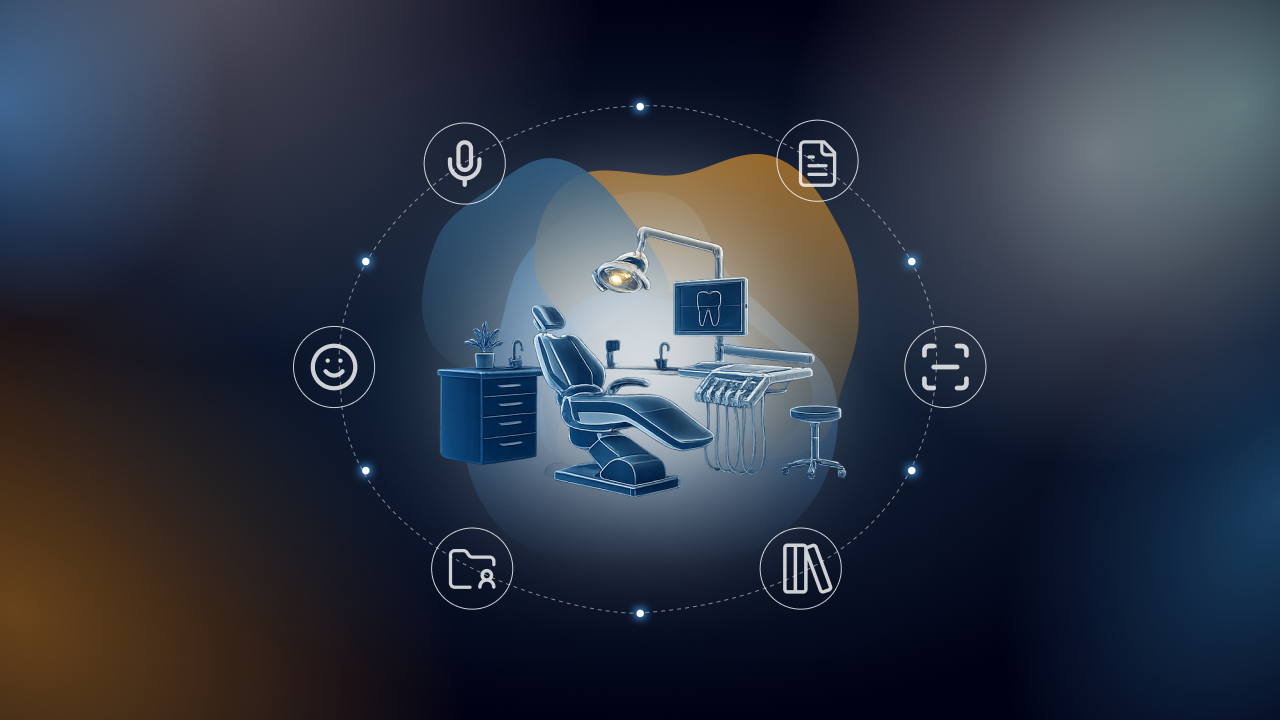
What Is a Virtual Patient? The Next Generation of Patient Records for Dentists
After the shift from paper to digital records, patient documentation is evolving again. With AI, a record can now develop and grow throughout a patient’s care. This is the emergence of the Virtual Patient.
Alexandre von Rakowski11 min read
Updated on August 10, 2026
Key takeaways from this article
What a Virtual Patient is.
Why this concept is emerging today.
How it differs from a traditional patient record.
The benefits for dentists.
Security and compliance considerations.
How this technology could transform practice in the coming years.
For decades, the patient record played a relatively simple role: keeping medical information, radiographs, administrative documents and treatment history. With the digital transformation of dental practices, it gradually moved from paper to digital, without fundamentally changing its function.
Today, artificial intelligence is opening a new chapter. Instead of simply storing information, a new generation of software is able to understand it, organize it automatically and enrich it over the course of appointments. This is what is known as a Virtual Patient.
In this article, discover what a Virtual Patient is, how it works, how it differs from a traditional patient record, and why this approach could durably transform the practice of dentists.
Why are people talking so much about Virtual Patients?
The concept of the Virtual Patient is relatively recent, but it fits into a broader evolution of digital dentistry. Practices now produce far more data than before: digital radiographs, clinical photographs, 3D models, reports, administrative documents and observations accumulate throughout the course of care.
At the same time, artificial intelligence has become capable of analyzing this information, connecting it, and automating certain tasks that used to be entirely manual. Software no longer just stores data: it is starting to understand it and use it to support the practitioner in their daily work.
Finally, the rise of the cloud and connected platforms now makes it possible to centralize all of this information in a single space, accessible securely from different devices and shared among the practice's various tools.
The Virtual Patient was born from the convergence of these three developments: the multiplication of health data, the progress of artificial intelligence and the emergence of platforms capable of bringing this information together within a single work environment.
What is a Virtual Patient?
A Virtual Patient is a dynamic digital representation of a patient. Unlike a traditional patient record, which mainly just stores information, a Virtual Patient automatically gathers, organizes and connects all the data relevant to clinical care.
It can notably bring together medical history, allergies, ongoing treatments, radiographs, clinical photographs, digital impressions, treatment plans, reports, or the practitioner's observations within a single environment.
But its real difference lies in its ability to evolve. With every new appointment, every new exam or every new piece of information, the Virtual Patient is enriched to offer an ever more complete and accurate picture of the patient. It is no longer simply a record that is filled in manually, but a digital representation that accompanies the practitioner throughout the course of care. This idea of a single, continuously enriched "source of truth" is at the heart of this new generation of tools.
Ultimately, the Virtual Patient is no longer limited to storing information: it becomes the central point from which the practice's various tools can retrieve relevant data, generate documents, assist with treatment planning, or facilitate access to clinical knowledge.
How does a Virtual Patient work?
A Virtual Patient can be created and enriched in different ways. The practitioner can enter information manually, but when paired with artificial intelligence tools, it can also evolve naturally over the course of conversations, appointments and new exams.
Manually creating and enriching the Virtual Patient
The practitioner can manually create a new patient's profile, enter their main information, then progressively add their exams, observations and documents. The Virtual Patient then becomes a centralized space that evolves throughout the course of care.
Automatically enriching the Virtual Patient with AI
Artificial intelligence makes it possible to go further by identifying relevant information as the practitioner works.
Take the example of CadSmile, the all-in-one AI assistant for dentists. A practitioner might start a conversation asking for advice about a 38-year-old patient with an abscess on a specific tooth. During the exchange, he mentions that she is pregnant, calls her Marie, then notes that she is allergic to penicillin. When he later refers to her as "Mrs. Dupont", her last name comes to complete the information already known.
This data can thus progressively enrich the same Virtual Patient, without forcing the practitioner to systematically interrupt his conversation to update the record separately. The Virtual Patient builds itself naturally over the course of practice and benefits from continuous updates as new information becomes available.
Centralizing the patient's exams, documents and simulations
This logic does not only apply to information gathered during a conversation. When a radiograph is added, its analysis can, for example, identify the presence of an implant and automatically enrich the Virtual Patient with this new information.
The same applies to clinical photographs, observations, documents or aesthetic simulations. A Smile Design created with another tool can be added to the Virtual Patient. When a platform directly integrates this feature, like CadSmile, the different proposals can also be generated and automatically saved in the same environment.
Throughout the course of care, the Virtual Patient is thus continuously updated based on information produced by different tools at different times. New data comes to complete what is already available, progressively building a more complete picture of the patient. If the practitioner later needs to prepare a treatment plan, find an observation, or write a letter to a colleague, they have a centralized view of the patient's history and relevant information.
What are the benefits of a Virtual Patient?
The value of a Virtual Patient does not lie solely in the amount of information it can gather. Its value comes above all from the way this data is centralized, updated and made available to the practitioner throughout the course of care.
Saving time and reducing repetitive tasks
When information gathered during an appointment can automatically enrich the Virtual Patient, the practitioner spends less time entering, filing or searching for data that is already available elsewhere. It also reduces the back-and-forth between different pieces of software to find a radiograph, an observation or a document.
Finding all the important information in one place
Radiographs, photographs, medical history, allergies, observations, documents or simulations can all be gathered around the same patient. The practitioner thus has a more complete view of their history without having to piece together information scattered across several tools.
This benefit becomes especially clear when a patient returns several months later or when a piece of information needs to be found quickly. An observation recorded during a previous appointment remains linked to the Virtual Patient and can be consulted whenever the practitioner needs it again.
Keeping a record continuously up to date
A traditional patient record largely depends on the information the practitioner remembers to enter and update. With a Virtual Patient enriched by artificial intelligence, new data can automatically complete what is already available over the course of appointments, exams and interactions.
This continuous update allows the Virtual Patient to evolve along with the patient. A new allergy, a recent radiograph, an identified implant, or a new treatment progressively enrich the same clinical representation.
Accessing the record from different devices
When built on a cloud platform, the Virtual Patient is not confined to the computer in a treatment room. The practitioner can retrieve the patient's information from different authorized devices, according to the access terms provided by the solution.
This accessibility makes it easier to consult a record outside the usual workstation, prepare for an appointment, or quickly access history when an unexpected situation arises.
Improving continuity of care
The more structured and accessible the information, the easier it becomes to retrieve a patient's context throughout their journey. The observations from an appointment, the exams performed, the decisions made and the documents produced are no longer seen as isolated elements, but as the different components of the same clinical history.
The Virtual Patient can thus become a shared point of reference for tracking the patient's progress and having the relevant information available when it is needed.
What are the constraints?
Centralizing and making greater use of patient data brings many benefits, but it also comes with specific requirements. Medical information, radiographs, photographs and clinical documents are sensitive data that cannot be stored or processed like ordinary files.
Protecting personal data and complying with the GDPR
In Europe, health data benefits from enhanced protection under the General Data Protection Regulation (GDPR). Its collection and processing must notably serve specific purposes, be limited to necessary information, and be covered by appropriate security measures.
For a dentist, choosing a Virtual Patient solution must therefore take into account how the data is collected, used, stored and protected.
Hosting health data in a suitable environment
In France, the hosting of personal health data is also regulated. When a solution falls within the scope of the HDS (Hébergeur de Données de Santé) regulation, this data must be hosted with a certified HDS host.
This requirement is particularly important for cloud platforms, since Virtual Patient information can be accessible from different devices while still being hosted in an environment designed to protect health data.
Keeping the practitioner at the center of decisions
A Virtual Patient can organize information, connect it, and use artificial intelligence to assist the practitioner. However, it must not automatically turn every detected piece of information into clinical truth.
The dentist must be able to verify and, when necessary, correct the information suggested by the AI. This human oversight is especially important when a piece of data could influence a clinical decision or the patient's care.
Choosing a solution suited to health data
Not every cloud platform or artificial intelligence assistant is necessarily designed to manage a patient record. Before adopting a solution, it is therefore important to check its security framework, its data-processing terms, and its suitability for the requirements that apply to healthcare professionals.
Specialized platforms like CadSmile can build these constraints in from the design stage. Data is then centralized in an environment intended for healthcare professionals, rather than spread across various consumer tools.
Paper record, digital record, or Virtual Patient?
The shift from paper records to digital records already greatly simplified the storage, search and access to patient information. The Virtual Patient represents a new evolution: beyond digitization, it notably uses artificial intelligence to organize, connect and enrich data throughout the course of care.
The three approaches are therefore not based on the same logic.
Criterion
Paper record
Traditional digital record
Virtual Patient
Centralized information
Limited
Yes
Yes
Access from different devices
No
Depends on the solution
Yes, depending on the solution
Manual addition of information
Yes
Mainly
Yes
Automatic enrichment of the record
No
Limited or absent
Yes
Continuous updates thanks to AI
No
Generally no
Yes
Connecting different pieces of data
Manual
Limited
AI-assisted
Taking the patient's context into account
By the practitioner
By the practitioner
By the practitioner and potentially by AI
Integration of different exams and documents
Physical / limited
Yes
Yes
Intelligent use of information
No
Limited
Yes, depending on the features
Dependence on digital infrastructure
No
Yes
Yes
A traditional digital record is already a major step forward compared to paper. The difference with the Virtual Patient lies mainly in what happens to information once it is recorded. It is no longer simply stored: it can be structured, connected and used by artificial intelligence to continuously enrich the representation of the patient.
The Virtual Patient today… and tomorrow
The Virtual Patient is no longer just a concept. The technologies needed for it to function already exist: artificial intelligence, the cloud, digital imaging, conversational assistants and software capable of centralizing different data sources are starting to converge within the same environments.
Today: centralizing and leveraging patient information
The first generations of Virtual Patients make it possible to bring together information that used to be scattered and to progressively enrich it over the course of care. Depending on the solution, they can incorporate clinical data, radiographs, photographs, observations, documents, or even treatment simulations.
Artificial intelligence adds a new dimension to this centralization. It can help structure information, find a relevant element, contextualize a response, or update the Virtual Patient as new data becomes available. The record is thus gradually becoming an environment the practitioner can interact with, rather than a simple storage space.
Tomorrow: toward an ever more complete representation of the patient
As dental tools become more connected, the Virtual Patient could incorporate more data from across the entire care journey: 2D and 3D imaging, digital impressions, data from practice-management software, treatment planning, or information produced by different professionals.
Interoperability will be key. The challenge will not simply be to accumulate more data, but to allow the different tools used by the practice to communicate with each other and enrich the same representation of the patient.
In the longer term, advances in artificial intelligence could also make it possible to use this representation in increasingly advanced ways to support treatment preparation, track its progress, or help the practitioner identify relevant information within increasingly rich records.
From patient record to true digital twin?
This evolution is gradually bringing the Virtual Patient closer to the concept of the digital twin, already explored in various fields of healthcare. A digital twin, however, goes further than an intelligent record: it seeks to create a digital representation of an individual that is detailed enough to model their condition and, eventually, simulate certain developments or interventions.
The Virtual Patient as it exists today is therefore not necessarily a digital twin in the strict sense. But the growing integration of clinical data, imaging, 3D models, and artificial intelligence could progressively bring these two concepts closer together.
Conclusion
The patient record has already gone through a first transformation by moving from paper to digital. With artificial intelligence, a new evolution is taking shape: that of a record capable not only of storing information, but also of organizing it, connecting it, and continuously enriching itself throughout the course of care.
The Virtual Patient is part of this evolution. By bringing together clinical data, imaging, observations, documents and simulations in a single environment, it gives the practitioner a more complete and more easily accessible view of each patient. As software becomes more integrated and interoperable, this representation could become even richer and gradually move closer to the concept of a digital twin.
The Virtual Patient therefore does not simply replace the traditional patient record. It changes the way information supports the practitioner throughout the course of care.
Discover how CadSmile's Virtual Patient builds and enriches itself throughout your practice
Centralize your patients' information in a single space that is continuously updated as you record appointments, exams and documents.
Choosing dental AI software is about more than comparing features or prices. Discover the criteria that will actually affect your day-to-day practice and learn how to evaluate any solution before committing.
AI automates certain tasks, speeds up data analysis, and improves access to information. But it does not replace clinical judgment, the patient relationship, or the dentist’s professional responsibility.
Clinical documentation is essential to patient care, but it also accounts for a significant share of dentists’ nonclinical workload. Discover how AI can help create documents faster, more clearly, and more efficiently—without replacing professional judgment.